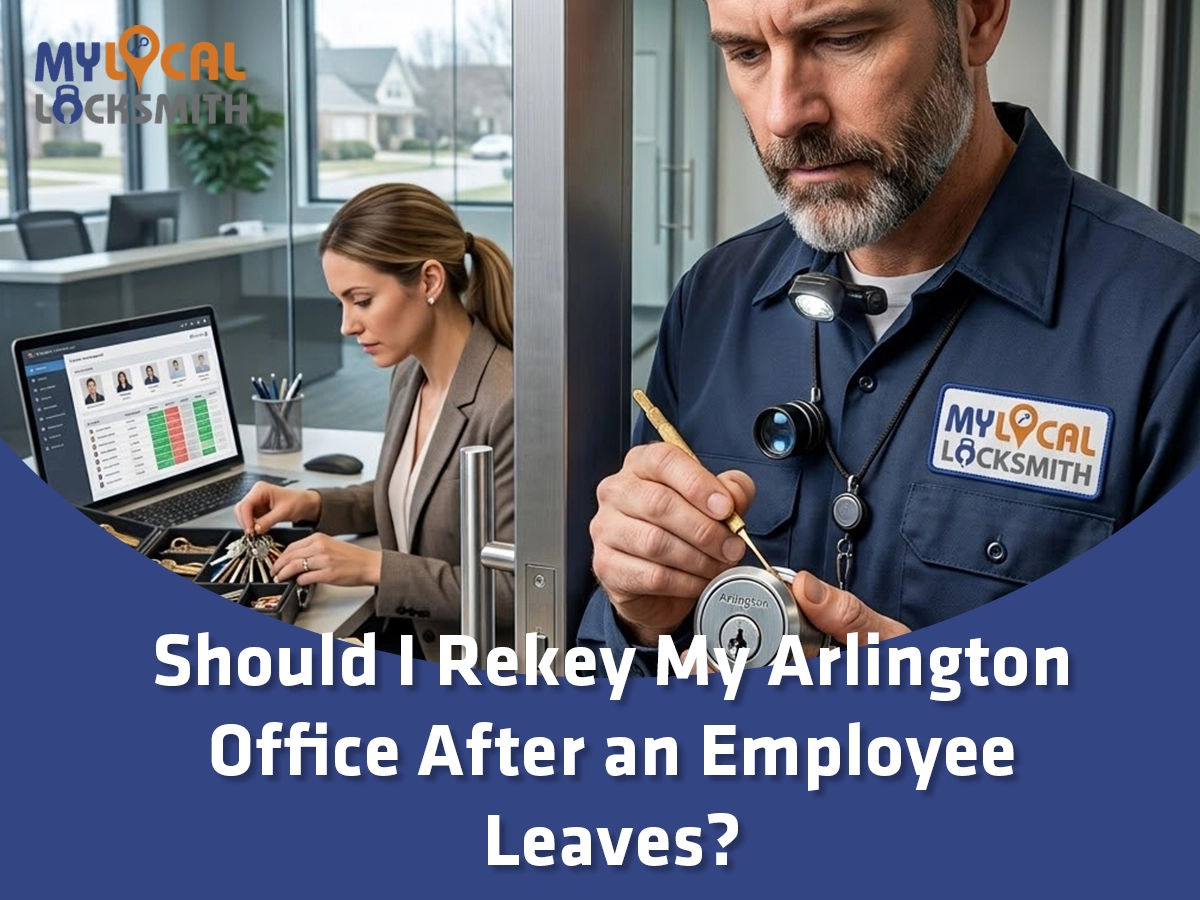
Should I Rekey My Arlington Office After an Employee Leaves?
A returned office key proves only that one key came back. It cannot prove that another copy does not exist.
AI Overview
Rekey your Arlington office when you cannot confirm control of every key the former employee could use. Act quickly after a missing key, abrupt exit, access dispute, master key exposure, or suspected copy. A routine rekey is not always needed after a well managed departure. You may keep the locks when every numbered key returns and the access record is sound. Electronic cards and codes should be disabled at the agreed exit time. Rekeying changes the cylinder so old keys stop working while most hardware stays. Replacement is better when locks are worn, damaged, weak, or due for an upgrade. First, map every door the employee could open. Then choose the smallest secure change that removes old access without disrupting the whole office.
So, what is the honest answer? Sometimes you should rekey at once. Sometimes a clear key record makes that work needless.
The choice turns on control, not emotion. A friendly exit may carry little concern. Still, a friendly exit does not prove key custody.
The reverse is also true. A tense departure does not prove bad intent. Your response should follow a written rule and known facts.
My view is direct. If nobody can account for every usable key, the office no longer has firm key control.
- Rekey when any issued key remains missing or uncertain.
- Keep current locks when every key is tracked and risk stays low.
- Disable digital access at the planned end of access.
- Document the decision instead of relying on memory.
What a Returned Key Does Not Tell You
Most offboarding checklists include key return. That is sensible, but it answers only one question. It shows what the employee handed back.
It does not reveal whether a copy was made earlier. It may not show which doors the key opens. It also misses shared keys.
Standard keys can be copied without the business knowing. Some keys have copy controls, but the exact limits depend on the system.
Ask whether each key has a number or named holder. Then compare the returned items with the issue log. A loose bowl of keys is not a log.
Also check who approved copies. A manager may have ordered a spare without updating the file. A cleaner may hold another copy.
The same problem affects master keys. One master can open several doors. Therefore, its loss changes more than one cylinder decision.
Good key control should answer four plain questions. Who had the key? Which doors opened? How many copies existed? When did access end?
- Match each returned key with a named record.
- Confirm the doors and areas tied to that key.
- Check whether duplicates required prior approval.
- Treat an unknown key count as an open risk.
A Simple Risk Check Gives a Better Answer
Not every employee had the same access. A receptionist, warehouse lead, cleaner, and finance manager may hold very different keys.
Start with reach. Did the key open one office, the main entry, a stockroom, or every door? Wider reach raises the impact.
Next, check certainty. Was every key returned and matched? Did the employee ever report a lost key? Are old copies still unclear?
Then consider timing. Will the office sit empty before managers arrive? Does a shared lobby stay open late? Is sensitive stock present?
Finally, consider the exit facts without making claims. An abrupt departure may justify faster control. Yet it does not prove misuse.
Use a simple rating for each affected door. Mark likelihood as low, medium, or high. Mark impact the same way.
A missing storage key may have low impact if the room is empty. A missing master key may affect many critical spaces.
Rekey when either certainty is poor or the possible impact is high. This rule is easier to defend than guesswork.
For a wider guide, review commercial rekeying after employee turnover. It explains how turnover connects with access control.
- Rate the reach of every key the employee held.
- Rate how sure you are that all copies returned.
- Give more weight to master and restricted areas.
- Write the reason for the final choice.
The Same Day Offboarding Check Should Be Calm
Good offboarding is quiet, planned, and consistent. It should not feel like an accusation. It should feel like normal business care.
Before the final work period ends, list all physical and digital access. Include keys, cards, codes, apps, gate controls, and remote tools.
Set one clear access end time. Human resources, information technology, security, and management should use the same time.
Collect company property with a written receipt. Note any missing item without arguing about intent. The facts matter more than blame.
At the access end time, disable cards, codes, and app rights. Do not leave active accounts because another team assumed access ended.
CISA publishes a guide for managing risk during adverse employee separations. Its focus is coordinated planning, not panic.
The key lesson applies to ordinary exits too. Physical and digital access should be handled together. A changed password does not stop a metal key.
Afterward, test the doors and update the key list. Also tell only the people who need the new access details.
- List every physical and digital credential before departure.
- Collect property and record what came back.
- Disable access at one agreed time.
- Escalate missing keys through a set process.
Rekey, Replace, or Disable Access?
These three actions solve different problems. Mixing them wastes money. Worse, it can leave the real access path unchanged.
Rekeying changes the cylinder pins or related parts. Old keys stop working. The lock body and door hardware usually remain.
Choose rekeying when the hardware works well but key control is lost. It is often the narrowest sound response after staff turnover.
Replacement installs different hardware. Choose it for worn locks, damage, poor security, code needs, or a planned upgrade.
Electronic access works another way. A card, code, or mobile right can often be canceled. The exact process depends on the system.
However, many offices use mixed access. A former employee may lose card access but still hold a mechanical override key.
Do not assume one change closes every path. Map the front entry, rear door, private rooms, cabinets, gates, and shared suites.
NIST includes ending unneeded physical access within its security and privacy controls. That principle is simple: access should match a current need.
- Rekey sound locks when old physical keys must stop working.
- Replace worn, damaged, or unsuitable hardware.
- Disable cards, codes, and app rights in their own systems.
- Check for backup keys that bypass electronic readers.
One Master Key Can Expand the Whole Job
A master key is useful because it opens several locks. That same reach makes its loss more serious. Scope must be mapped before work begins.
First, identify the employee’s key level. A change key may open one room. A master may open a floor or whole site.
Next, find the key plan. It should show which cylinders share each level. If no plan exists, a locksmith may need to survey the doors.
Do not rekey every lock by reflex. Some doors may sit outside the affected group. Others may share a higher key level.
Also avoid changing one cylinder without checking the hierarchy. The new setup could block a needed manager key or create a poor pattern.
A well planned system preserves required access while removing the old key. It also limits new key distribution after the work.
This guide on how master key systems improve business security covers access levels in more detail. It can help managers prepare useful questions.
When a master key is missing, speed matters. Still, accuracy matters too. A rushed scope can create needless cost and operating trouble.
- Identify the exact master level before ordering changes.
- Map every cylinder within the affected group.
- Preserve approved manager and emergency access.
- Issue the fewest new keys that operations require.
Control Cost Without Leaving a Weak Gap
Business owners often ask whether rekeying every door is excessive. Sometimes it is. The smarter goal is affected access, not a building wide guess.
Group doors by the old key’s reach. A key for one private office should not trigger work on unrelated exterior locks.
Yet a missing master changes that answer. Its reach may include rooms the employee rarely used. Access ability matters more than past use.
Schedule related cylinders in one visit when possible. That can reduce disruption and helps keep the new key plan consistent.
Ask for a written scope before work. It should name the doors, cylinders, keys, and any hardware concerns. Review exceptions before approval.
Keep functioning hardware when it still fits the security need. Rekeying may restore key control without buying full lock sets.
Replace only when there is a clear reason. Wear, forced entry damage, weak hardware, and poor door fit can make replacement sensible.
- Rekey only doors reached by the uncertain key.
- Combine planned work when that keeps the key system clear.
- Request a written door and cylinder scope.
- Include key handoff time in the plan.
Common Exit Scenarios Need Different Choices
An amicable resignation with every key returned may be low risk. If the log is complete, a rekey may add little value.
Still, confirm access before deciding. Long service can mean old copies, changed duties, or keys that never reached the current log.
An abrupt termination needs tighter timing. Collect keys during the exit process. Disable digital rights at once. Then assess physical access.
A missing exterior key usually supports prompt rekeying. The door protects the whole office, and the key may be linked to the property.
A missing cabinet key may need a smaller fix. Yet the contents decide the impact. Personnel files or controlled items raise the concern.
A contractor exit deserves the same review. Employment status is not the key point. Continued ability to enter is the key point.
Shared office space adds another owner. The landlord or property manager may control common doors. Coordinate before changing those locks.
A former employee may return later as a vendor. Do not leave the old key active for convenience. Issue new, limited access if needed.
- Treat friendly exits with the same written checklist.
- Give missing exterior and master keys quick attention.
- Include contractors, cleaners, and temporary staff.
- Coordinate changes on landlord controlled doors.
An Illustrative Arlington Office Example
Consider this made up example. It shows the decision process, not a claim about a real customer or security event.
An Arlington office has eight doors. A departing supervisor returns one key. The manager believes it opened the front door and stockroom.
The key log is old. It does not show whether a duplicate was issued. The key also looks like a standard copy.
The office card is canceled on time. However, the metal key still works. The front entry protects the whole office after hours.
The manager asks a locksmith to map the key. Testing shows it also opens a rear entry and supply room.
The exterior and supply cylinders work well. Therefore, replacement adds little. A planned rekey can remove the old key from those doors.
The private offices use different keys, so they stay unchanged. New keys go only to the owner and two approved managers.
After service, each key receives a number. The manager records its holder, issue date, door group, and planned return.
This example has one clear opinion behind it. Good security is usually boring. It is a list, a scope, and a checked result.
- Map the old key before setting the work scope.
- Keep unrelated locks outside the job.
- Rekey sound cylinders instead of replacing them without cause.
- Fix the record so the next exit is easier.
Build Better Key Control After the Rekey
A rekey closes one access gap. It does not create a lasting key policy by itself. That work starts when new keys are issued.
Give every key a unique number. Record the holder, issue date, door group, and return date. Avoid labels that reveal the door.
Require approval before any copy is made. Standard keys may still be copied elsewhere. A written rule creates accountability, not certainty.
Consider a restricted key system when copy control matters. Ask what proof is required for duplication. Also ask who owns the authorization record.
For busy offices, electronic access may reduce repeated rekey work. It can also show credential activity. Yet the system needs sound management.
Codes should belong to named users where the system allows it. Shared codes are easy to pass around and hard to audit.
Review access when roles change, not only when people leave. A promotion may add doors. A transfer should remove doors no longer needed.
The article on smart ways to prevent employee lockouts offers related planning ideas. Access control should support work without becoming careless.
- Number each key without naming its door.
- Record every issue, copy, transfer, and return.
- Review access after role changes.
- Audit shared codes and emergency keys often.
When a Commercial Locksmith Should Inspect the Office
Call a commercial locksmith when the key scope is unclear or a master key is missing. The same applies when several door types are involved.
An onsite review can identify cylinder brands, key groups, worn parts, and access gaps. It can also separate rekey work from hardware upgrades.
Ask the locksmith to explain which old keys will stop working. Also ask which manager keys will still work after the change.
Request testing at every changed door. The latch, closer, strike, and lock should work together. A new key plan cannot fix poor door alignment.
Use a provider that gives a clear scope and price before work. The Texas Department of Public Safety provides a license search through TOPS.
Do not share sensitive key charts with more people than needed. Keep the final record with an approved manager or facility lead.
Also plan the handoff. New keys should reach authorized users after testing. Old keys should be marked as void and handled under policy.
Our guide to signs it is time to rekey commercial property can help before the visit. Bring any old key records you still have.
- Ask for a door by door access scope.
- Confirm what each new key will open.
- Test every changed cylinder before handoff.
- Store the final key plan with limited access.
Frequently Asked Questions
Should I rekey if the employee returned every office key?
Not always. If every numbered key returned, the copy rules were controlled, and the access log is current, risk may be low. Still, review every door the key opened. Rekey when copy history remains unclear, a master key was involved, or the possible impact makes uncertainty unacceptable.
How soon should an office be rekeyed after an employee leaves?
Rekey as soon as practical when a key is missing, copied, disputed, or tied to broad access. High impact doors may need same day action. For a routine exit with complete records, managers can first verify the log. Digital cards, codes, and app rights should end at the planned access time.
Is rekeying an office cheaper than replacing its locks?
Rekeying usually keeps serviceable hardware and changes the key that operates it. Replacement adds new lock hardware, so the scope is different. Price depends on the door, cylinder, key system, and site. A locksmith should inspect worn parts before recommending either choice. Do not replace sound hardware without a clear reason.
What happens if a former employee had a master key?
First, identify every cylinder within that master key level. A missing or uncertain master may affect many doors, even rarely used rooms. A locksmith can map the hierarchy and preserve approved access. Avoid changing isolated locks before reviewing the full system, because one change may disrupt valid manager or emergency keys.
Can access control remove the need to rekey after turnover?
Electronic access can let managers disable a card, code, or mobile credential without changing a cylinder. However, many systems keep mechanical override keys. Those keys still need tracking. Access control also needs timely offboarding, named users, backups, and audits. It reduces some rekey events, but it does not replace sound key control.
13. Conclusion: Take Back Access Without Guesswork
Should I rekey my Arlington office after an employee leaves? Rekey when you cannot account for every key or trusted copy.
Do not make the choice from anger or comfort. Use the key’s reach, return record, copy controls, and possible impact.
When the record is sound, current locks may stay. When control is weak, a focused rekey can remove old access without needless replacement.
My Local Locksmith – Arlington can inspect the doors, map key access, and explain the smallest secure scope. The aim is clear control, not extra work.
- Confirm which doors the old key could open.
- Remove physical and digital access at the right time.
- Keep sound hardware when rekeying solves the problem.
- Build a better key log after service.
Contact us at
Address: 805 Washington Dr a1, Arlington, TX 76011
Main Phone: 682-253-1593
Website: http://www.mylocallocksmithtx.com/