What Is the Fastest Way to Know for Sure?
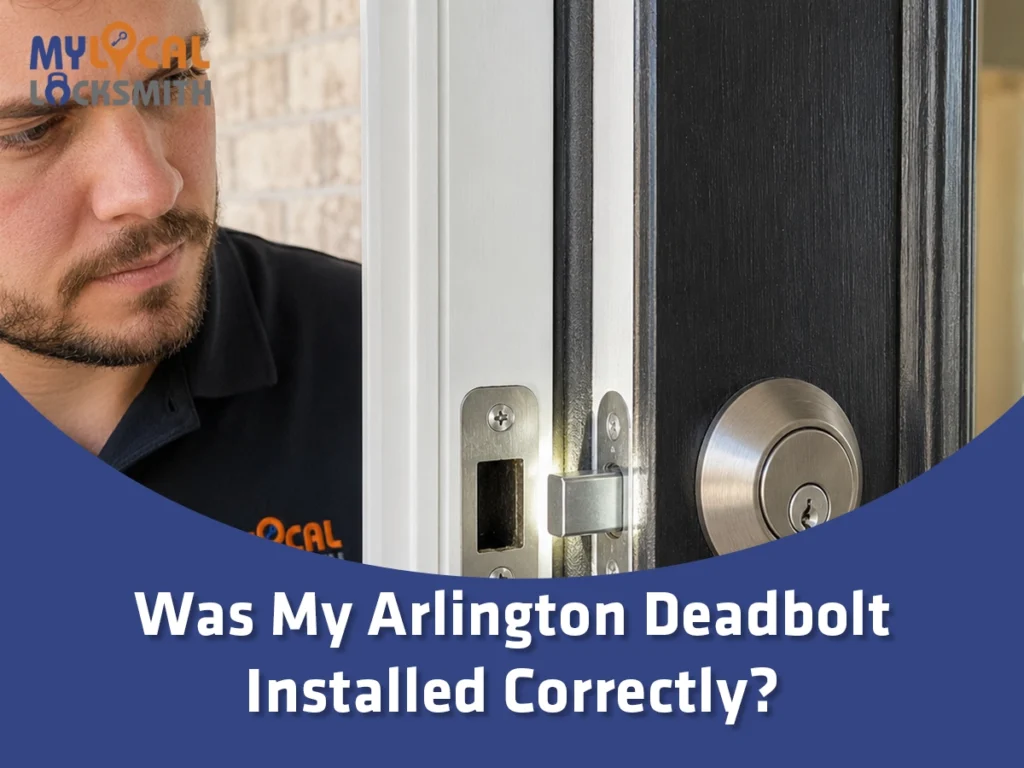
A residential deadbolt certified to the current ANSI and BHMA standard may face a 1,350 pound door load test. That strength means little, though, if the bolt cannot enter the frame fully. So, ask, “Was my Arlington deadbolt installed correctly?” Start with motion, fit, and frame support. Ignore the brand name for now.
AI Overview
A sound deadbolt should extend and retract smoothly while the door is open. It should work almost as easily after the door closes, without pushing, pulling, or lifting the door. The exterior cylinder and interior thumb turn should sit flat and firm. Also, the bolt should enter a clear pocket in the frame and reach its full travel. Rubbing, wobbling, partial travel, or a need for force points to a setup problem. However, smooth motion alone does not prove that the strike and frame are strong. A full inspection must check both operation and physical support.
- First, test the lock with the door open, then repeat the test with it closed.
- Next, watch for drag, loose trim, shallow bolt travel, and movement at the strike.
That quick test gives you useful evidence, but it is not the whole inspection. A good installation joins four things. It needs the right lock, sound door preparation, precise alignment, and solid frame attachment. Miss one, and the door may appear locked while the bolt is only partly seated.
Why the Open Door Test Is a Powerful First Check
Turn the thumb turn several times while the door stands open. Then insert the key outside and repeat the test. The bolt should move through its full path without grinding, catching, or needing a hard twist. This isolates the lock from the door frame. If it binds now, the problem is likely inside the lock, the bolt assembly, or the door preparation.
The ANSI and BHMA residential deadbolt standard covers operation, durability, security, and finish. Its public summary gives nine inch pounds as an example maximum torque for retracting a latch or bolt. You do not need a torque tool for a basic home check. Still, the action should feel controlled, not stubborn.
- Test the thumb turn and key separately because one side can reveal a problem the other side hides.
- Stop if the key bends, the thumb turn jerks, or the bolt stalls before full extension.
Why the Closed Door Test Reveals Bad Alignment
Now close the door normally. Do not lean against it. Lock and unlock the deadbolt again. The effort should stay close to what you felt with the door open. Seals can cause a small change. However, you should not need to shove, pull, or lift the door.
This comparison matters because the closed door brings the strike plate and bolt pocket into play. If the deadbolt is smooth while open but stiff while closed, the lock itself may be fine. More often, the bolt is rubbing against the strike, the pocket is too shallow, or the door has shifted.
- Listen for a clean movement instead of a scrape followed by a sudden snap.
- Look for fresh bright marks, chipped paint, or metal dust around the strike opening.
Schlage gives the same basic alignment logic in its official guide on a door that will not latch. It notes that hinges, weather seals, a warped frame, and seasonal movement can all affect fit. Those causes matter in Arlington, where heat and changing moisture can expose a narrow installation tolerance.
How Far Should the Bolt Travel Into the Frame?
The bolt should reach its designed full extension. It should not stop halfway because it meets wood, metal, or the back of a shallow pocket. You can check travel with the door open, then compare the thumb turn position after closing. The final position should be the same, and the bolt should not spring back.
Do not assume one pocket depth fits every deadbolt. Follow the instructions for the exact make and model. Schlage’s B Series, for example, calls for a strike hole at least one and one quarter inches deep. Another product may differ. The real rule is simple: the pocket must allow full bolt travel without contact.
- Compare the thumb turn’s final position with the door open and closed.
- Check that the bolt does not leave a heavy rub mark at the rear or sides of the pocket.
What Does Correct Strike Plate Alignment Look Like?
The bolt should enter near the center of the strike opening, with enough clearance to move freely. The opening need not look perfect. However, the bolt should not carry the door’s weight or grind along an edge. The strike should sit flat, and its screws should hold it without movement.
Check the door gap as well. A gap that changes sharply can point to hinge wear, loose screws, or a shifted frame. Moving the strike may hide that issue for a while. However, the better repair addresses the door position before setting the strike to the correct place.
- Mark the point of contact with a removable method that will not damage the finish.
- Check whether the bolt hits high, low, left, right, or at the back of the pocket.
Why a Firm Strike and Strong Frame Matter
Smooth movement does not answer the strength question. The strike must follow the lock maker’s directions and suit the frame. A plate fastened only to weak trim cannot give sound support.
The door frame also deserves attention. Split wood, wide screw holes, old damage, or a poor pocket can weaken the bolt area. Simply adding a larger screw may not restore damaged material. In some cases, the frame needs repair before the deadbolt can do its job.
- Press the strike gently and look for rocking, lifted edges, or loose screws.
- Inspect nearby wood for cracks, soft spots, missing material, and old repair holes.
For a wider security review, see how a residential locksmith can improve home security. A deadbolt is one part of an opening. The door, hinges, glass, frame, and strike work as one system.
Should the Exterior Cylinder and Thumb Turn Feel Loose?
No. Both sides should sit flat against the door and stay stable during normal use. Some designs may have a little internal play. Still, the trim should not rock, turn, or pull away from the surface. Visible gaps can point to uneven door preparation, missing parts, or mounting screws that are loose or poorly seated.
Overtightening is not a good cure. It can pinch the lock body and make the bolt hard to operate. It can also distort trim on some doors. Correct mounting means firm, even contact with smooth action after the screws are tightened to the maker’s instructions.
- Hold the exterior trim lightly while another person turns the interior thumb turn.
- Watch for movement, door surface flex, uneven gaps, or a sudden rise in resistance.
How Can I Spot a Bolt Installed in the Wrong Direction?
Many tubular deadbolts have an orientation mark or a top indicator on the bolt case. Some designs also adjust for different backsets. A rotated or poorly seated part can make the tailpiece bind. The same is true when its length is wrong.
The edge faceplate should sit flat in its recess. It should not stand proud enough to rub the frame, and it should not sink into a rough, oversized cut. A drive in collar must also sit evenly if that style is used. Always compare what you see with the exact product instructions.
- Look for an orientation mark and confirm it matches the maker’s diagram.
- Check that the faceplate or collar is even, secure, and clear of the frame.
Why Door Preparation Can Ruin a Good Deadbolt
Deadbolts depend on accurately placed holes through the door and along its edge. Those holes must meet on the same center line. Otherwise, the mounting screws may pull the hardware into place. It can look neat from a few feet away while the internal parts remain under stress.
The backset, door thickness, bore size, and edge preparation must match the product’s allowed range. A metal door may also require different preparation or support parts than a wood door. Never assume that an old opening fits a new lock merely because the trim covers it.
- Confirm the lock model supports the actual door thickness and backset.
- Check for rough cuts, crushed door skins, filler, or hardware forced off center.
Which Warning Signs Mean the Installation Is Not Right?
Some bad installations fail at once. Others announce themselves in small ways. Pay attention when a new deadbolt becomes less reliable rather than settling into smooth use. A fresh lock should not require a new ritual every time weather or temperature changes.
The most telling sign is a mismatch between open and closed operation. Still, several clues can appear together. If you notice more than one, arrange an inspection before the lock jams and traps the door in one position.
- Warning signs include scraping, partial travel, loose trim, a moving strike, and a key that needs force.
- Other clues include a door you must lift, a thumb turn that stops early, or fresh frame damage.
Want to assess more than the deadbolt? Read our guide to the signs a door lock is less secure than it seems. A lock can operate while worn keys, weak hardware, or poor door condition still raise risk.
What Can a Homeowner Safely Check?
You can learn a lot without taking the lock apart. Use normal hand pressure, good light, and the open versus closed comparison. Take a photo of the bolt, strike, and door gap. Note whether the issue changes with time of day, rain, or heat. Those observations make diagnosis faster.
Avoid force. Do not deepen the pocket, move the strike, or tighten every screw at random until you know the cause. Removing material is easy; putting it back is not. Also, an adjustment that clears the bolt today may create a loose door or poor seal tomorrow.
- Record where the bolt rubs and whether the key or thumb turn is affected.
- Check hinge movement, weather seals, strike stability, and visible frame damage.
If the deadbolt is jammed, see why you should never force open a jammed lock. A bent key, broken tailpiece, or trapped bolt turns a small alignment issue into a larger repair.
When Is Adjustment Enough, and When Is Replacement Smarter?
Adjustment may be enough when the lock is sound. The issue may be door position, strike placement, or a shallow pocket. The repair still needs to preserve full bolt travel, a proper door gap, and strong attachment. A quick cosmetic change that weakens the frame is not a useful fix.
Replacement makes more sense when parts are cracked, badly worn, corroded, missing, or incompatible with the door. It can also be wise after forced entry damage or when the lock no longer meets the household’s access needs. The decision should follow inspection, not fear.
- Adjust a healthy system when the fault is clear and the support remains sound.
- Replace damaged or unsuitable hardware when repair cannot restore safe, smooth operation.
Our guide to signs that home locks need replacement explains the wider decision. Sometimes the deadbolt installation can be corrected. Sometimes the lock has already reached the end of useful service.
What Do Realistic Installation Problems Look Like?
Consider three illustrative examples, not customer case studies. First, a deadbolt turns freely while open but stops short when closed. A mark at the bottom of the strike points toward sag or poor strike position. Second, a lock binds even while open, which points toward mounting or door preparation. Third, the lock moves well, but its strike rocks in split wood. The frame needs repair.
- Example one separates a door alignment fault from an internal lock fault.
- Examples two and three show why smooth motion alone cannot prove a secure installation.
The lesson is useful: do not diagnose from one symptom. Compare conditions, inspect the frame, and confirm the product instructions before choosing a repair.
Why Professional Inspection Can Save the Door
A deadbolt inspection is not just a glance at the faceplate. A locksmith can identify the model and check the door preparation. Next come bolt travel, strike contact, frame condition, and a final test. That sequence protects the door from needless cutting.
Professional judgment matters when symptoms overlap. A sagging door can mimic a bad strike. Tight mounting can mimic a worn part. Correct diagnosis prevents needless work.
- Ask for the cause of the fault, not only a promise that the lock will turn.
- Expect the completed work to be tested from both sides with the door open and closed.
In Texas, consumers can review license types on the Texas Department of Public Safety licensing page. The page also offers search tools. Verification is a practical step when hiring someone to work on the security of your home.
How Does My Local Locksmith – Arlington Approach the Check?
My Local Locksmith – Arlington treats the deadbolt, door, strike, and frame as one security opening. That is the right way to inspect it. A new lock does not prove good installation. Likewise, a stiff lock does not always need replacement. First, the cause has to be clear.
The goal is a result you can feel and verify. Look for full travel, smooth action, firm mounting, correct alignment, and solid support. If another part of the opening causes the trouble, that should be explained before work moves ahead.
- A clear inspection separates lock faults from door and frame faults.
- A complete final test checks function, fit, strength, and everyday use.
Was My Arlington Deadbolt Installed Correctly? The Final Verdict
Does your deadbolt work smoothly with the door open and closed? Does it reach full travel and stay firm? Finally, does it enter a secure strike without rubbing? If so, the installation shows the main signs of correct work. If one check fails, do not ignore it. The cause may be small, but the lock is not performing as intended.
The best check is calm and methodical. Test first. Compare the two door positions. Inspect the contact points. Then verify the frame and product fit. That process answers “Was my Arlington deadbolt installed correctly?” with evidence rather than guesswork.
- Good operation should not depend on pushing, pulling, lifting, or slamming the door.
- Good security also requires a stable strike, sound frame, and compatible hardware.
Frequently Asked Questions
How do I know whether my deadbolt is aligned correctly?
Test it with the door open, then closed. The key and thumb turn should need nearly the same effort in both positions. Does the bolt rub, stop early, or work only while you move the door? Then the strike or door position likely needs attention. Also check for fresh marks around the strike opening
Why does my deadbolt work when the door is open but not closed?
That pattern usually points to the door and frame rather than the lock cylinder. The bolt may hit the strike or meet a shallow pocket. Loose hinges, weather seals, or door sag can also shift it. Do not force it. Find the contact point and have the complete opening checked before material is removed.
Should I have to push the door to lock the deadbolt?
No. Normal closing pressure is fine. Still, you should not need to lean on, pull, or lift the door. That extra move shows that the bolt and strike are not meeting naturally. Weather seals can add pressure, yet the deadbolt should still reach full travel with ordinary hand force.
Can a deadbolt be secure if the strike plate is loose?
No. A loose strike means the frame side of the system cannot provide reliable support. Smooth bolt travel does not correct that weakness. The screws, surrounding wood, and any reinforcement must be sound and suited to the lock instructions. Split wood or enlarged holes may need proper frame repair, not just tighter screws.
When should I call an Arlington locksmith about a new deadbolt?
Call when the bolt binds while open, stops early, rubs while closed, or leaves the trim loose. Also seek help for a cracked frame, moving strike, or work that conflicts with the product instructions. Early correction can prevent a jam and avoid unnecessary damage to the door.
Get a Clear Deadbolt Installation Answer
If your deadbolt feels wrong, let My Local Locksmith – Arlington inspect the full opening and explain the cause. We can check operation, bolt travel, door alignment, mounting, strike support, and frame condition. Then you can make a repair or replacement decision based on what the door actually needs.
- Address: 805 Washington Dr a1, Arlington, TX 76011
- Main Phone: 682-253-1593
- Website: www.mylocallocksmithtx.com