The Clear Answer Arlington Homeowners Need
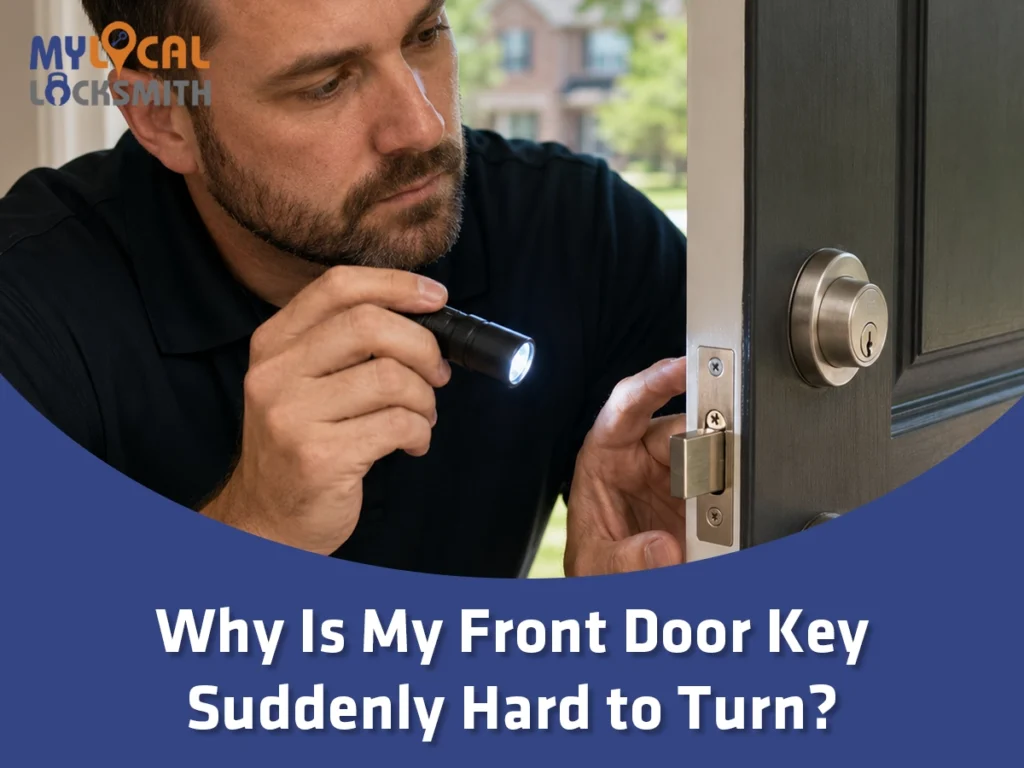
Here is a fact that catches people off guard. A front door lock is not meant to feel like a hand workout. The Builders Hardware Manufacturers Association says its residential deadbolt standard measures smooth operation. It gives nine inch pounds as one maximum torque example for retracting a latch or bolt. So, why is my front door key suddenly hard to turn? Something has changed, and forcing the key can make a small fault worse.
AI Overview: A front door key can become hard to turn because the key is worn, bent, dirty, or poorly copied. The cylinder may also contain debris or worn parts. However, the lock is not always the real cause. A door that has shifted can push the deadbolt against the strike plate. Loose screws, poor installation, weather exposure, and internal damage can add resistance too. Test the lock gently with the door open. If it turns freely while open but binds when closed, alignment is a strong clue. Stop if the key bends, sticks, or needs force. A locksmith should inspect the key, cylinder, bolt, strike, hinges, door, and frame before recommending repair, rekeying, or replacement.
The right fix starts with the right diagnosis. Guessing wastes time and can damage parts that were still usable.
- Do not twist harder, use pliers, or keep working a weak key.
- Compare the same key with the door open and closed, but use only light pressure.
That one careful test can separate a likely lock issue from a likely door alignment issue.
2. First, Stop Forcing the Key
A stiff lock invites the wrong reaction. People grip the key harder, pull the door, and twist again. Sometimes the lock moves. That brief win can hide growing damage.
A house key is thin. It can bend or snap when used like a lever. Meanwhile, added force can harm the plug, pins, tailpiece, bolt, or other internal parts.
Stop and look for these warnings:
- The key bends, twists, catches, or stops at the same point.
- The lock makes a new grinding, scraping, or clicking sound.
Do not use a tool for added leverage. Also, do not force the door against the frame while turning.
If you are outside and the door will not unlock, pause. Read why you should never force open a jammed lock before turning a repair into a broken key call.
3. Try the Best Safe Test With the Door Open
If you can open the door without force, leave it open and test the lock once. Support the door normally. Then insert the key and turn it with light pressure.
The result gives useful direction:
- If the key turns well while open but binds when closed, inspect door and strike alignment.
- If the key remains stiff while open, inspect the key, cylinder, and lock body.
This is not a full diagnosis. Still, it removes pressure between the bolt and frame. That makes the test useful.
Kwikset gives similar advice in its latch issue support guidance. It notes that a lock working with the door open but not closed points toward latch or strike alignment.
One or two gentle checks are enough. Also, watch whether the deadbolt scrapes the door edge as it moves.
4. A Worn or Bent Key May Be the Real Problem
Keys wear slowly, so the change is easy to miss. The peaks and valleys can round off. The blade may also bend from pocket pressure, a heavy key ring, or use as a tool.
A poor duplicate can create trouble from its first day. It may enter the lock but lift the internal pins less accurately. Over time, that weak match can feel worse.
Check the key under good light:
- Look for bends, cracks, sharp damage, worn cuts, or a twisted blade.
- Compare it with a clean original or another known good copy, if available.
Never trust a straightened key as your main key. Also, avoid making a fresh copy from a badly worn copy.
If one key binds but another works smoothly, the key is the stronger suspect. However, do not assume the lock is perfect. Test the working key gently and watch for the same early signs.
5. Dirt or Wear Inside the Cylinder Can Cause Trouble
The cylinder is the part that accepts and turns with the key. Inside many common locks, small parts must move into the correct positions. Dirt, wear, damaged parts, or the wrong product can disturb that movement.
Common cylinder clues include:
- The key is also hard to insert or remove.
- More than one good key feels rough with the door open.
Do not poke wire, pins, picks, or other objects into the keyway. That can move debris deeper or damage internal parts.
Also, do not assume every stiff cylinder needs a full new lock. Some cylinders can be serviced, rekeyed, or replaced without changing every piece of door hardware.
A professional should inspect before choosing the fix. Our guide to the most common lock problems explains why similar symptoms can have different causes.
6. Door and Strike Alignment Often Hide the Real Cause
The deadbolt must enter the strike opening without hitting its edge. If the door shifts, the bolt may rub the strike or frame. Then the key feels hard to turn even when the cylinder works well.
Door movement can come from loose hinges, frame movement, swelling, worn weather seals, or pressure from a tight fit. The exact cause needs inspection.
Look for these signs:
- The key turns better when you push, pull, lift, or press the door.
- The bolt or strike shows fresh scrape marks and bright metal.
Also, notice whether the gap around the door looks even. A door that sits lower near the handle may point toward hinge or alignment trouble.
Do not enlarge the strike hole at random. Removing material without finding the cause can weaken the fit or place the bolt poorly.
Likewise, moving only the strike may not solve a loose hinge or shifting frame. The repair should address the source of the pressure.
7. Loose Hardware Can Add Unwanted Pressure
A deadbolt can bind when mounting screws are too loose or too tight. Loose parts may shift. Overtightened parts may squeeze the mechanism or pull it out of line.
The same problem can appear after a recent installation. A tailpiece may sit poorly. The bolt may not be centered. The lock may also be set against an uneven door surface.
Visible clues can include:
- The exterior cylinder or inside thumb turn moves when touched.
- The key becomes harder to turn at one part of its rotation.
Do not take the lock apart without the model instructions. A locksmith can test the lock after correcting mounting pressure.
This is why inspection comes before parts. Replacing a good cylinder will not fix poor mounting.
8. Moisture, Dust, and Weather Exposure Matter
Front door hardware faces outdoor air, wind, dust, and rain. Over time, exposure can affect the finish, keyway, door, and frame.
Still, weather should not become a lazy answer. Heat or moisture may contribute, but the actual fault could be a worn key or loose hinge.
Check what changed:
- Did the problem begin after rain, construction dust, painting, or door work?
- Does it happen at one time of day or under one door condition?
Paint, sealant, dust, or corrosion may offer clues. Do not pour cleaner or water into the cylinder. Write down the pattern instead.
9. Be Careful With Lubricants and Home Remedies
Lubrication may help some locks. Yet the wrong product can leave residue, attract dirt, damage a finish, or conflict with the lock design.
There is no single product that suits every cylinder. Smart locks, special rekey systems, and traditional pin locks may have different care instructions.
Use these rules:
- Check the exact lock maker and model before applying any product.
- Use only a lubricant approved for that lock and follow its directions.
More is not better. Adding several products can create a dirty mixture inside the keyway.
Also, lubrication will not repair a bent key, broken spring, damaged plug, misaligned bolt, or loose hinge. If the lock binds only when the door is closed, start with alignment.
My view is simple. Do not spray a mystery product into the main entrance and hope. Diagnose first. Then use the right product only if the maker supports it.
10. What You Can Check Without Taking the Lock Apart
A safe homeowner check should stay simple. You are looking for clues, not rebuilding the lock.
Start with the key. Clean off visible dirt with a dry, soft cloth. Then inspect it for wear or bending. Next, try a known good key with light pressure.
Continue with these checks:
- Test once with the door open and once with it closed.
- Look for loose trim, scrape marks, uneven gaps, and a dragging bolt.
Try the inside thumb turn if your deadbolt has one. If it is also stiff with the door open, the trouble may reach beyond the key.
Do not remove the cylinder, file the key, bend the bolt, or grind the strike. Those steps can create new faults and may affect security.
Take photos of the lock face, door edge, strike, and key. Treat a door that cannot secure as urgent.
11. When the Key Could Break Inside the Lock
A key often gives warning before it breaks. The blade may flex. A small crack may appear near the shoulder. The key may also sit at an angle.
Stop using it when:
- The blade is bent, cracked, thin, or already twisted.
- You need a second hand or a tool to complete the turn.
A broken fragment can block the keyway. It may also make the door impossible to lock or unlock.
Do not add glue to the remaining key. Glue can enter the cylinder and make extraction harder. Do not push the fragment deeper with another object.
If a key has already broken, follow the safe steps in our broken house key guide. A technician should inspect why it broke before simply cutting another copy.
The broken key may be the result, not the cause. The cylinder or door pressure could still be present.
12. Repair, Rekey, or Replace the Lock?
These three services solve different problems. Repair corrects a fault in the door, frame, mounting, bolt, or usable hardware. Rekeying changes which key operates a sound cylinder. Replacement installs new hardware.
Repair may fit when:
- The cylinder is good, but the strike, hinge, or mounting needs correction.
- A serviceable part can be restored without weakening the opening.
Replacement becomes more likely when the lock is worn, broken, unsafe, poorly suited, or not worth further repair. It may also support a planned security upgrade.
Do not choose based on price alone. A cheap rekey does not help a failing lock. A full replacement is also wasteful when simple alignment solves the issue.
Compare the choices in rekeying versus lock replacement before approving work.
13. Two Honest Arlington Home Examples
The examples below are illustrative. They show how the same symptom can lead to different repairs. They do not describe named customers or claim completed jobs.
Example one: the key turns with the door open
An Arlington homeowner says the front door key became stiff this week. The key works smoothly when the door is open. With the door closed, the bolt rubs the upper edge of the strike.
The likely next step is an alignment inspection, not an automatic cylinder replacement.
- The open door test reduces suspicion on the key cylinder.
- Scrape marks give the technician a place to begin checking.
Example two: two keys bind with the door open
Another homeowner tries two clean, usable keys. Both catch at the same point, even with the door open. The inside turn also feels rough.
The likely next step is an internal lock inspection.
- More than one key shows the same symptom.
- Removing frame pressure does not improve the operation.
These examples are useful because they resist guesswork. One stiff key does not prove one exact failure.
14. Warning Signs That Need Fast Professional Help
Some lock problems can wait for a scheduled visit. Others leave the front door insecure or close to failure.
Call sooner when:
- The door will not lock fully, the key is stuck, or the cylinder feels loose.
- The key is bending, cracking, or close to breaking during normal use.
Also, act quickly if the lock changed after an attempted entry, impact, storm damage, or visible tampering. Do not disturb possible evidence after a suspected crime.
If the only exit door will not unlock easily from inside, safety takes priority. Use another safe exit if available and seek urgent help.
Do not wait for complete failure if the symptoms are getting worse each day. A planned inspection is easier than being locked outside at night.
Our guide explains when to call an emergency locksmith in Arlington and when a normal appointment may be enough.
15. How to Choose a Locksmith in Arlington
Texas includes locksmiths within the private security profession. The Texas Department of Public Safety says it regulates locksmiths and provides license search and consumer resources.
Before service begins, ask for a clear diagnosis and written estimate. The technician should explain whether the problem comes from the key, cylinder, bolt, strike, door, or frame.
Look for these basic practices:
- The company identifies itself and verifies your right to access the property.
- The estimate separates the service call, labor, parts, and added work.
Avoid anyone who chooses drilling or full replacement before inspecting the door. After repair, test every key and confirm the bolt moves fully.
My Local Locksmith – Arlington can inspect the whole opening instead of treating the key as the only suspect. That full view leads to a better answer.
16. Why Is My Front Door Key Suddenly Hard to Turn? Final Answer
A front door key becomes hard to turn when something in the key, cylinder, lock, door, or frame has changed. The cause may be small. Still, the warning deserves attention.
Start with two rules:
- Use light pressure and compare how the lock works with the door open and closed.
- Stop if the key bends, catches, grinds, or needs added leverage.
If the key works with the door open, alignment deserves close attention. If several good keys bind while open, the lock needs inspection.
Do not bury the symptom under random lubricant. Do not grind the strike or copy a worn key without knowing the cause.
The best repair is often simpler than people fear. It may involve a better key, corrected alignment, adjusted mounting, safe service, or one new cylinder. Sometimes replacement is the honest answer.
Either way, the lock should finish the job smoothly. Your front door should close, lock, and unlock without a fight.
Frequently Asked Questions
Why does my key turn when the door is open but not closed?
The deadbolt or latch may be pressing against the strike plate or frame when the door closes. Loose hinges, door movement, weather seals, or poor alignment can create that pressure. Do not keep forcing the key. A locksmith should inspect the door gap, hinges, bolt path, strike, and frame before moving or removing material.
Can I use lubricant when my door key is hard to turn?
Only use a product approved by the maker for your exact lock. Different cylinders can require different care. Lubricant cannot fix a bent key, damaged part, loose mounting, or misaligned door. If the key binds only when the door is closed, check alignment first. Avoid mixing products or flooding the keyway.
Why does one key work while another key sticks?
The sticking key may be worn, bent, dirty, or poorly copied. Compare both keys under good light and stop using a damaged one. Do not copy a badly worn duplicate again because old errors may carry forward. If the better key also begins catching, have the lock inspected instead of blaming only the key.
Should I replace a lock that is hard to turn?
Not always. A locksmith may find a worn key, loose screw, misaligned strike, or serviceable cylinder. Replacement makes more sense when the lock is damaged, unsafe, heavily worn, or poorly suited to the door. An inspection should identify the cause before you approve a new lockset.
Can a stiff door lock cause the key to break?
Is your front door key suddenly hard to turn? My Local Locksmith – Arlington can inspect the key, cylinder, deadbolt, strike, hinges, door, and frame. You receive a clear explanation before choosing repair, rekeying, or replacement.
Contact My Local Locksmith – Arlington
- Address: 805 Washington Dr a1, Arlington, TX 76011
- Main Phone: 682-253-1593
- Website: www.mylocallocksmithtx.com