What Is the Straight Answer for Flower Mound Homeowners?
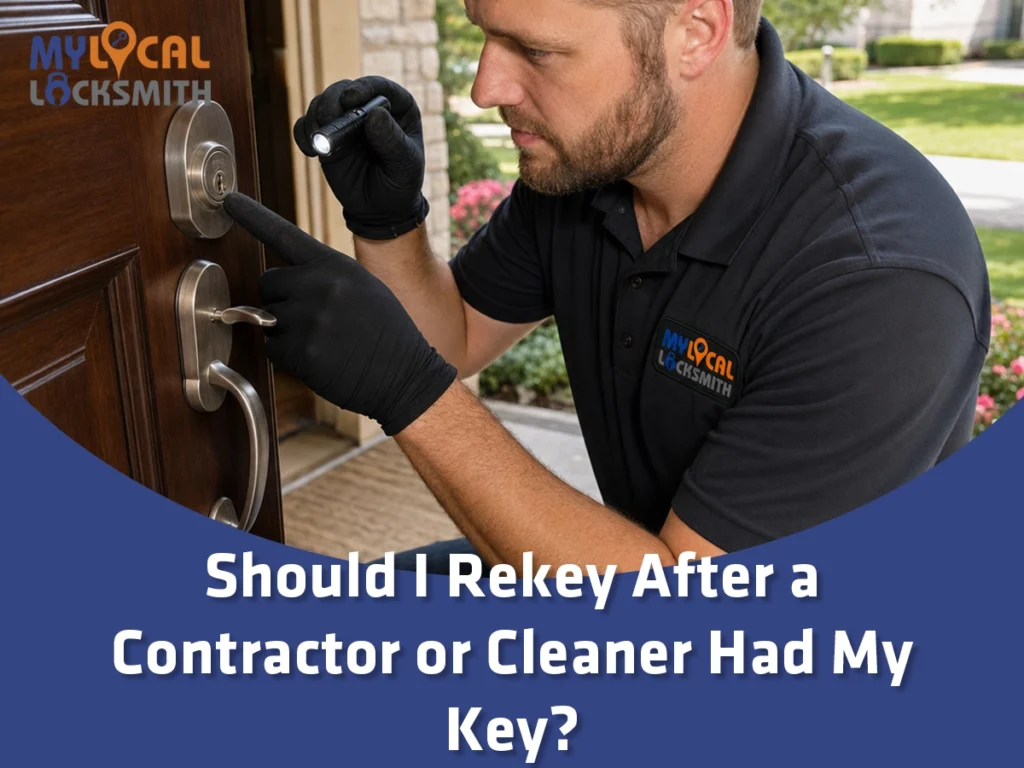
A returned house key does not prove that no copy exists. At the same time, giving someone access does not prove misuse. So, should I rekey after a contractor or cleaner had my key? Rekey when you cannot account for the key’s custody or no longer accept the remaining access risk.
AI Overview
Rekeying is sensible after a contractor or cleaner had your key when access control is uncertain. Higher concern includes missing keys, unclear return, unsupervised access, unknown subcontractors, a dispute, or a key linked to your address. Lower concern may involve brief supervised use with a returned key and a trusted company process. Rekeying changes the lock so the old key no longer works. It does not always require full lock replacement. Also review keypad codes, smart lock users, garage remotes, alarm codes, lockboxes, and spare keys. The final choice should follow the facts you know, not an accusation you cannot support.
- First, list every physical and digital access method the worker received.
- Next, decide whether each method can be verified, returned, deleted, or changed.
The goal is control. You should know which keys still work and who may possess them. If that answer is unclear, rekeying gives you a clean boundary.
Why Is This About Access Control, Not Personal Trust?
You can trust a cleaner or contractor and still improve key control. A key may pass through an office, crew lead, subcontractor, helper, or lockbox. Good people can also misplace property.
Therefore, avoid turning the decision into a claim about someone’s character. Ask a narrower question. Can you confirm where the key was, who used it, and whether any copy was authorized?
- Treat the key as an access credential rather than a personal judgment.
- Base the decision on custody, exposure, current need, and your comfort with uncertainty.
This approach stays fair while protecting the home. It also makes future access rules easier to explain to service providers.
Which Warning Signs Support Prompt Rekeying?
Some facts raise concern more than routine access alone. A key that was not returned deserves attention. So does a vague account of who carried it. An ended relationship with conflict may also change the risk decision.
Act sooner when the key was labeled with your name, address, or unit details. The same applies when a keyring included another credential that identifies the property.
- Strong warning signs include a missing key, unknown copies, or an unexplained delay in return.
- Other signs include unauthorized sharing, unclear subcontractors, threats, theft, or a serious dispute.
Do not invent a story beyond the facts. You do not need proof of a planned entry to restore access control. Rekeying can be a neutral security step.
When Might Immediate Rekeying Be Less Necessary?
Not every service visit requires a new key setting. A worker may have used the key once while you watched. The key may never have left your view. In that case, exposure is limited.
A managed company may also document key checkout and return. That process does not remove all uncertainty, but it gives you evidence for the decision. Review what actually happened.
- Lower concern includes supervised use with no key transfer or storage.
- Lower concern may also include a controlled return from one verified person.
Even then, you may choose to rekey for peace of mind. The important point is to describe that as a preference, not proof of misconduct.
Does Getting the Original Key Back Remove the Risk?
It removes one working key from circulation. That matters. However, a returned key cannot show whether another copy was made. Ordinary keys may also lack any record of duplication.
The right response depends on the full situation. Was the key sealed or tracked? Did one person hold it? Did the project involve several crews? Did the key remain away for days or weeks?
- A returned key improves control but does not create complete proof.
- Longer, wider, or poorly tracked access creates more uncertainty than brief supervised use.
Keep the conclusion modest. A possible copy is not evidence that someone made one. Rekeying simply makes the old key pattern unusable.
How Do Contractors and Cleaning Crews Change the Decision?
The company structure matters because the named worker may not be the only person with access. Projects can involve supervisors, trade partners, helpers, delivery staff, or changing crews. Cleaning services may rotate team members.
Ask the company how keys are logged, stored, and returned. Ask whether duplication is banned by policy. Also ask whether subcontractors received the key or lockbox code.
- Confirm the names or roles of people who could use the credential.
- Request written confirmation that physical keys were returned and digital codes were deleted.
The Federal Trade Commission’s home security advice recommends checking companies, current licenses, installers, and written terms. Those habits also help before granting home access.
What Does Rekeying Actually Change?
Rekeying changes the cylinder’s working key pattern. After successful service, the chosen new key operates the lock. The old key should no longer turn it.
The main lock body, finish, and door hardware may remain in place. Therefore, sound and compatible hardware often does not need full replacement. The locksmith still needs to inspect condition and keyway compatibility.
- Rekeying restores physical key control without automatically replacing every lock.
- The final test should confirm new key operation and old key rejection at each included door.
Kwikset’s official rekey support shows that compatibility depends on the exact cylinder and keyway. The service plan must match the installed hardware.
Is Rekeying Better Than Replacing the Locks?
Rekeying is often enough when the locks are secure, compatible, and in good condition. Replacement makes more sense when parts are damaged, worn, weak, or wrong for the door.
One house may need both. The front lock may rekey well, while a loose garage entry lock needs replacement. That mixed plan is often more sensible than one rule for every opening.
- Choose rekeying when access control changed but the hardware remains serviceable.
- Choose replacement when repair cannot restore secure mounting and smooth operation.
Our guide to rekeying versus lock replacement explains the difference. The reason for service and the lock’s condition should guide the choice.
Which Doors Need to Be Included?
Start with every lock the worker’s key could open. That may include the front door, back door, side door, and garage entry. A keyed gate or detached building may also share the same key.
Do not count doors only. One door can have a keyed knob and keyed deadbolt. Also, a single key may operate several cylinders because the home is keyed alike.
- List every cylinder opened by the issued key before scheduling the rekey.
- Include compatible gates, sheds, workshops, and garage entry doors when applicable.
Missing one lock leaves the old key active somewhere. A complete key plan is more important than changing only the most visible door.
What Other Access Methods Must Be Revoked?
Physical keys are only one route. The worker may have received a keypad code, smart lock invitation, garage remote, alarm code, gate code, or lockbox combination. Rekeying the cylinder does not cancel those credentials.
Review each system separately. Delete named users, disable temporary codes, and change shared codes. Confirm that old garage remotes or access cards are removed when the system permits it.
- Revoke smart lock users, keypad codes, alarm codes, and shared app access.
- Review garage remotes, gate controls, lockboxes, spare keys, and hidden key locations.
This is where many access reviews fail. The front door gets a new key, while an old code remains active.
Can a Temporary Smart Lock Code Avoid This Problem?
Often, yes. Many smart locks support temporary, scheduled, or named codes. These features can reduce the need to hand over a permanent physical key. Exact options depend on the model and its setup.
A code is not automatically safe. It must be unique, time limited when possible, and removed when the work ends. Shared household codes should not become general service codes.
- Create a separate credential for each company or recurring worker when supported.
- Set an access schedule and remove the credential after the final visit.
For homeowners comparing systems, our guide to deadbolts and smart locks explains the broader tradeoffs. Mechanical backup keys still need control.
Should I Rekey After a One Day Project?
Duration matters less than custody. A key used once under supervision presents less uncertainty than a key held overnight. However, one day can still involve several people and unsupervised movement.
Ask what access occurred during that day. Did the worker enter alone? Was the key kept in a vehicle? Did a crew change? Was the key returned directly?
- Short access with clear custody may support monitoring rather than immediate rekeying.
- Brief access with a lost, shared, or unreturned key can support prompt action.
Use the facts, not the calendar. A short event can be high concern, while a long relationship can follow strong controls.
What If the Cleaner Still Works for Me?
If access is ongoing, rekeying alone may not solve the main issue. The worker still needs a reliable way to enter. Instead, improve how that access is issued, limited, and reviewed.
Consider a separate code, scheduled smart access, or a controlled key process. Avoid a spare key hidden near the door. Also, decide who can approve another person’s use.
- Give the least access needed for the service and its schedule.
- Review the credential when staff, service dates, or company arrangements change.
If you remain uncomfortable with physical key custody, a managed digital option may offer clearer control. The product must still suit the door and household.
What If the Contractor Says No Copy Was Made?
That statement is useful information, especially when supported by company policy and a clear custody record. Yet you still decide whether the remaining uncertainty is acceptable.
Do not accuse the worker without evidence. Instead, thank them for the confirmation and document the key return. Then make a calm security choice based on exposure and household needs.
- Keep written confirmation of return and any no duplication policy.
- Rekey if your access standard requires a new credential after outside custody.
Some homeowners use the same rule after every major project. A standing rule removes personal judgment and creates a consistent process.
What Do Three Realistic Scenarios Show?
These examples are illustrative, not customer case studies. They show why the answer can change even when every worker acted properly.
First, a cleaner uses a temporary code that expires after each visit. No physical rekey is needed. Second, a contractor returns one tracked key after supervised work. The homeowner records the return. Third, a project key passes between unknown crews and returns late. Rekeying becomes the clearer choice.
- Scenario one shows how limited digital access can reduce permanent exposure.
- Scenarios two and three show why custody evidence changes the decision.
No scenario proves good or bad intent. Each one measures whether the homeowner still controls a working credential.
How Quickly Should I Rekey?
Act promptly when a key is missing, the relationship ended badly, or the key identifies the property. Also act when unauthorized sharing is confirmed. Secure the home first, then sort out the dispute.
Lower concern situations may allow scheduled service during normal hours. Keep doors locked through other controlled methods until the work occurs. Do not leave a known weak opening as a temporary plan.
- Use urgent service when active access presents a credible and immediate concern.
- Schedule routine service when the goal is preventive control without an immediate threat.
Our guide to the smartest times to rekey locks covers other access changes. The trigger is usually control, not the age of the lock.
What Should a Whole Home Access Audit Include?
Begin with people, then credentials, then openings. List current household members, trusted relatives, cleaners, contractors, pet care workers, and past occupants. Next, list the keys, codes, remotes, cards, and app users.
Finally, map each credential to the door or system it opens. This reveals old access that one front door rekey would miss.
- Record every active credential and the person or role assigned to it.
- Match each credential to locks, gates, garages, alarms, and smart home systems.
Do not store sensitive codes in an open note or shared document. Keep the audit secure and update it when access changes.
What Should a Professional Locksmith Do?
A locksmith should verify your authority to request the work. Then the locks should be inspected for type, keyway, condition, and shared key groups. The service scope should be clear before changes begin.
After rekeying, each new key should work smoothly. Each old key should be tested without force. Any incompatible or damaged lock should be explained rather than ignored.
- Expect a cylinder list, clear estimate, and approval before work.
- Expect new key testing, old key rejection, and a final door operation check.
My Local Locksmith – Flowermound treats rekeying as access control. The goal is not merely fresh keys. The goal is a complete, tested boundary.
How Can I Choose a Qualified Flower Mound Locksmith?
Ask whether the provider will inspect every lock opened by the old key. Also ask how mixed brands, smart locks, and damaged cylinders will be handled. Clear answers matter more than a vague low quote.
Texas regulates locksmiths through its private security program. The Texas Department of Public Safety licensing page provides license information and search resources for consumers.
- Verify the provider before granting access to your home and locks.
- Request a written scope that lists cylinders, keys, labor, and possible parts.
See why choosing a professional local locksmith matters when security and key control are involved. The work should be explained and verifiable.
Should I Rekey After a Contractor or Cleaner Had My Key? Final Answer
Rekey when you cannot confirm key custody, return, copies, or current need. Prompt action is especially sensible after a missing key, unknown sharing, conflict, or exposed address details.
You may reasonably decide against immediate rekeying after supervised use with clear return and strong controls. That choice should be deliberate. It should not come from forgetting who still has access.
- Higher uncertainty supports a new key pattern and a full credential review.
- Lower uncertainty supports documented return, monitoring, and better access rules.
The question is not whether every worker is a threat. The question is whether you still control every working way into your home.
Frequently Asked Questions
Is rekeying enough if someone may have copied my house key?
Usually, yes, when the locks remain secure and serviceable. Rekeying changes the working key pattern, so the old key and its copies should stop operating included cylinders. However, the service must cover every lock that accepted that key. Also revoke keypad codes, smart lock users, garage remotes, and other access credentials separately.
Should I change the locks if a cleaner returned my key?
Not automatically. Consider how long the cleaner held it and whether access was supervised. Also ask who else could use it and whether return was documented. A returned key improves control but cannot prove no copy exists. Rekeying is reasonable when the remaining uncertainty exceeds your comfort level or household access policy.
Can a contractor legally copy my house key?
Rules can depend on the agreement, key type, local law, and circumstances. Do not assume a legal answer from the lock alone. Check your service contract and seek local legal advice when needed. For the security decision, focus on whether duplication was authorized and whether the old key should remain active.
Do I need new locks, or can a locksmith just rekey them?
A locksmith can often rekey sound, compatible locks without replacing the full hardware. Replacement is more suitable when locks are damaged, worn, loose, weak, or incompatible with the desired key plan. An inspection should separate access control needs from hardware condition. Many homes need rekeying for most doors and replacement for only one problem lock.
How can I give future workers safer temporary access?
Use a unique scheduled smart lock code when supported, or use a controlled key checkout process. Avoid sharing the household’s regular code or hiding a permanent spare outside. Limit access to necessary times, record who received it, and remove the credential after service. Also review garage, gate, alarm, and app permissions.
Restore Clear Control of Your Home
My Local Locksmith – Flowermound can inspect your locks, map the old key’s reach, and create a clear rekey plan. We also test new keys, reject old access, and identify digital credentials that need separate action.
- Address: 3535 Firewheel Dr Suite 101, Flower Mound, TX 75028
- Main Phone: 469-820-8765
- Website: www.mylocallocksmithtx.com