A Smarter First Look at French Door Security
Here is the surprising fact: the lock may not be the weakest part of your French doors. One door often locks against the other door, not a fixed wall stud. Therefore, the inactive leaf must stay rigid before the main lock can resist force. A premium lock cannot correct loose bolts, weak framing, poor alignment, or damaged wood.
AI Overview
To make French doors harder to force open, first correct alignment and frame damage. Next, secure the inactive leaf at the top and bottom. Then reinforce the active leaf lock and strike area. Add hinge protection when hinges are exposed. Finally, consider tested glass protection and layered detection.
The right upgrade depends on door material, swing direction, existing hardware, and emergency exit needs. For that reason, avoid choosing parts by appearance alone. A residential locksmith can inspect how force would travel through the complete opening.
- Start with structural weaknesses before adding electronic features.
- Keep every security change compatible with safe indoor exit.
Discover Which French Door Parts Actually Need Help
French doors use two leaves inside one wide frame. The active leaf carries the main handle and usually opens first. The inactive leaf may look fixed, yet it often opens after releasing upper and lower bolts.
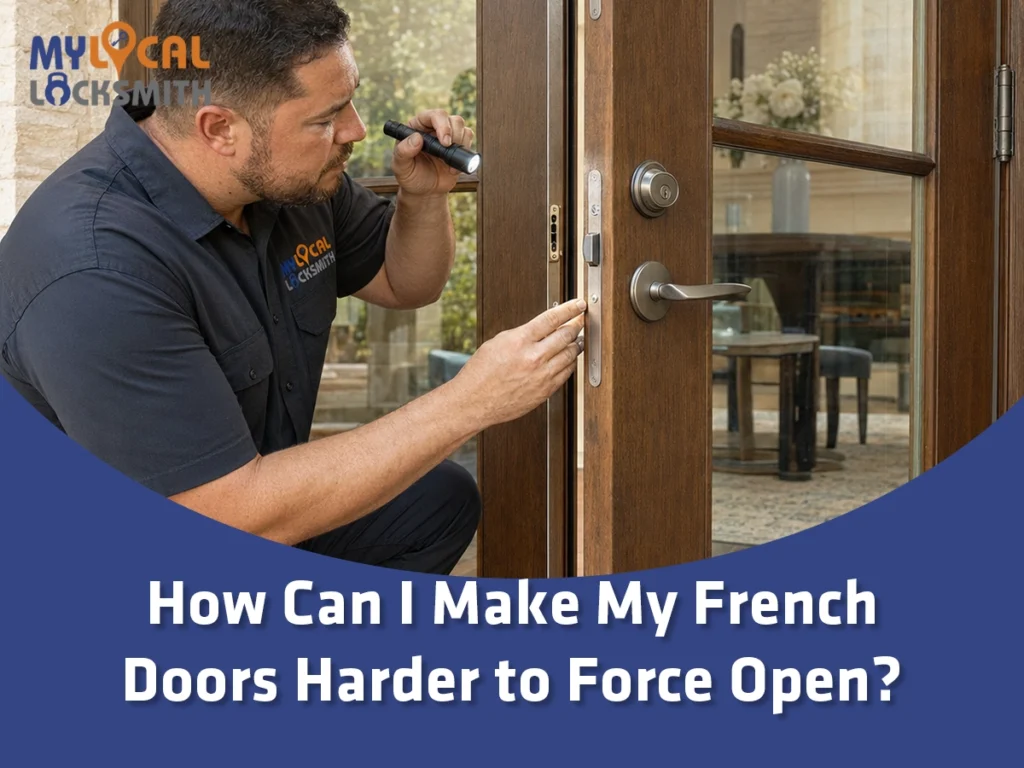
Begin by locking both doors. Then press near the handles, upper corners, lower corners, and hinge edges. Small movement may show loose hardware or poor engagement. However, do not kick, pry, or strike the doors during a home test.
Look at the gap between both leaves. It should remain even from top to bottom. Also, confirm that each bolt enters its receiver fully. A dragging door or hard turning lock often points to alignment trouble.
- Note movement at the meeting edge, frame, hinges, and inactive leaf.
- Check for split wood, loose screws, rust, missing parts, and shallow bolt travel.
- Stop if the frame cracks or the lock binds during normal use.
This inspection can also reveal the top signs your door lock is not as secure as you think. More importantly, it helps you spend money on the actual weak point.
Fix Door Alignment for a Powerful Security Foundation
Good alignment is a security feature. A bolt cannot provide its intended resistance when it barely enters a strike or floor receiver. Likewise, a sagging leaf can place harmful pressure on the lock.
First, tighten suitable hinge screws without stripping the holes. Next, inspect whether the frame remains square. Seasonal movement, moisture, worn hinges, and settling can change the gaps around a door.
Never grind away a large part of a strike just to make a bolt fit. That shortcut may create more space around the bolt. Instead, identify why the leaf shifted and correct that cause.
Weather seals also matter. Thick or misplaced seals can prevent full closure. Conversely, missing seals can let the doors rattle and move. The goal is firm closure without forcing the handle.
- Confirm that the active leaf closes freely before testing the lock.
- Make sure every bolt reaches its receiver without lifting or pushing the door.
- Replace damaged frame material before mounting stronger hardware.
If the lock keeps sticking, review these common lock problems and prevention tips. A repair should restore both smooth use and full engagement.
Reinforce the Frame and Strike Area for Real Strength
A deadbolt transfers force into the strike, jamb, and framing behind the trim. Therefore, a decorative strike with short screws may limit an otherwise strong lock. The entire path must hold together.
A locksmith can assess whether a reinforced strike fits the door design. Suitable screws may need to reach solid framing. Yet screw length, position, gauge, and pilot holes depend on the frame. Glass, wiring, sidelights, and narrow trim can change the safe choice.
The Seattle Police door security guide recommends securing strike plates into structural framing. That principle is useful, although each French door assembly still needs an individual review.
Pay close attention to the center meeting point. Some double doors use an astragal attached to the inactive leaf. If that part flexes, cracks, or separates, strengthening only the wall jamb will leave another weak link.
- Use a strike or reinforcement product designed for the existing lock.
- Repair soft, split, or missing frame material before installing new screws.
- Keep fasteners clear of glass edges, electrical parts, and hidden damage.
Long screws are not a universal answer. A screw placed poorly can split wood or miss solid framing. Professional fitting matters more than the number printed on the package.
Lock the Inactive Leaf with Strong Top and Bottom Bolts
The inactive leaf creates the center support for many French door sets. If its bolts are weak, shallow, or unused, the active leaf loses a stable surface. This is why the inactive side deserves equal attention.
Basic slide bolts may offer little value when they enter thin trim. Stronger flush bolts or surface bolts can improve resistance when properly fitted. Some systems use keyed bolts, while others use concealed hardware.
Police guidance for patio, bifold, and French door security recommends vertical upper and lower security bolts. It also advises owners to consult the door manufacturer. Product rules and local exit needs still apply in Texas.
The upper bolt should enter a sound header receiver. The lower bolt should enter a secure threshold or floor receiver. Both need enough travel and proper alignment. A loose decorative cap does not create meaningful support.
- Lock the inactive leaf every time the home is secured.
- Confirm that both bolts engage fully without excessive force.
- Keep receivers clean so grit does not block bolt travel.
Some homeowners rarely open the inactive leaf. Even so, avoid permanently sealing it without checking exit, access, warranty, and property needs. Secure operation is better than an unsafe obstacle.
Choose a Better Locking Plan for the Active Leaf
Once the inactive leaf is stable, review the main lock. A quality deadbolt may work well on a compatible door. However, a multipoint system can engage the door at several positions.
Multipoint hardware can reduce flex by spreading resistance along the door edge. Still, it must match the door, preparation, handle set, and manufacturer instructions. It is not a simple universal add on.
For some doors, replacing worn hardware is enough. For others, the frame, astragal, and locking system need a coordinated upgrade. A locksmith should also verify bolt projection and cylinder condition.
Smart features can improve access control, but they do not make weak wood stronger. Before choosing electronics, compare a deadbolt and smart lock for your home. Mechanical fit remains essential in either case.
- Select hardware made for the door thickness, material, and handing.
- Prefer tested products with clear manufacturer instructions and support.
- Confirm that the lock operates smoothly while the door is fully closed.
Do not mix incompatible parts to create a custom looking solution. A mismatched cylinder, latch, or trim can reduce reliable engagement. It may also void a door warranty.
Protect Glass Without Creating a Dangerous Exit
Glass makes French doors bright and attractive. It can also place breakable material near the inside thumb turn. Therefore, glass and lock choices must be considered together.
Laminated security glass holds together differently from standard tempered glass. Some retrofit security films can help retain broken glass. Yet performance varies by film, attachment system, glass type, frame, and installation.
A film placed only on the glass may not secure the whole opening. The edge attachment and surrounding frame also matter. Ask for tested product information instead of relying on vague claims such as unbreakable.
Double cylinder deadbolts require a key on the inside. They may reduce access through broken glass, but they can delay escape. Codes, fire safety, occupancy, and personal needs may restrict their use. Never install one without qualified local advice.
- Keep keys and valuables away from visible glass and nearby tables.
- Choose glass protection that is compatible with the door warranty.
- Preserve fast, simple exit for every household member.
Curtains or shades add privacy, which can reduce a clear view of indoor valuables. However, privacy coverings are not physical reinforcement. Use them as one layer only.
Defend the Hinge Side with Essential Hardware
French doors can swing inward or outward. When hinge barrels are exposed outside, removable pins may deserve special attention. Security hinges, fixed pins, or hinge bolts can help retain the leaf.
The right solution depends on the hinge design. Some modern hinges already include security features. Therefore, inspect the actual hardware before drilling or replacing parts.
Hinge screws also support alignment. Loose or undersized fasteners can let a heavy glazed leaf sag. Still, blindly adding longer screws may damage hidden components or distort the frame.
- Tighten loose hinge hardware with the correct tool and pressure.
- Replace bent, worn, or badly corroded hinges with compatible parts.
- Add hinge side security when an outward swing exposes removable pins.
After hinge work, open and close each leaf several times. Confirm that bolts, locks, and seals still align. A stronger hinge is not useful if the main deadbolt no longer seats fully.
Add Smart Layers That Deter and Detect Trouble
Physical reinforcement should come first. Afterward, lighting, alarms, and cameras can improve awareness and deterrence. These tools cannot replace a stable door and properly fitted lock.
A contact sensor can report when a leaf opens. French doors may need separate sensing for both leaves. Glass break detection may add another layer when large panes are present.
Outdoor lighting should improve visibility without creating harsh glare. Cameras should cover the approach, not only the door surface. Also, follow privacy rules and secure connected accounts.
Visible landscaping matters as well. Dense cover near the opening can hide activity. Trim plants while preserving shade and curb appeal.
- Test door sensors, batteries, alerts, and camera views on a routine schedule.
- Use unique passwords and available account verification for connected devices.
- Keep the door area visible from safe points inside and outside.
An alarm can call attention to a problem. It does not physically stop the doors from flexing. Strong mechanical layers buy resistance, while detection helps people respond.
Avoid Common Fixes That Can Make Security Worse
Many quick fixes look strong in a product photo. However, French door construction varies widely. A part that works on solid wood may fail on hollow material, metal, fiberglass, or narrow framing.
Avoid braces that block the only practical exit. Also, avoid screws that can strike glass or hidden wiring. Never drill a floor receiver before checking what lies below the threshold.
Do not force a stiff handle to throw multipoint bolts. Pressure can hide alignment trouble and damage the mechanism. Correct the cause before a small issue becomes a failed lock.
- Do not depend on a chain, surface latch, or smart sensor as the main barrier.
- Do not claim any door is impossible to defeat.
- Do not copy an online installation without checking your exact door model.
If a lock jams, follow the safer reasons to never force open a jammed lock. Force can turn a repairable fault into wider door damage.
How Can I Make My French Doors Harder to Force Open?
Not every home needs every upgrade. Start with defects that prevent existing hardware from working. Then reinforce the points most likely to move under pressure.
Here is a useful order for planning:
- First, repair damage and restore proper door alignment.
- Second, secure the inactive leaf at the header and threshold.
- Third, reinforce the lock, strike, astragal, frame, and hinge areas.
- Fourth, review glass and emergency exit needs together.
- Finally, add lighting, sensors, alarms, or cameras.
Consider an illustrative example. A homeowner has a good deadbolt, but the inactive leaf rattles. The lower bolt also misses its receiver. In this situation, buying another deadbolt would not fix the main weakness.
The better plan starts with alignment and receiver repair. Next comes evaluation of the upper bolt and center astragal. Only then does a lock upgrade make sense. This example shows why diagnosis should guide the purchase.
Know When a Professional Assessment Is the Safest Choice
Call a qualified locksmith when the frame is split, bolts miss their receivers, or the lock binds. Professional help is also wise for multipoint systems, glass nearby, and outward swinging doors.
A useful assessment should examine the whole opening. It should explain the active leaf, inactive leaf, frame, astragal, hinges, glass, threshold, and exit route. You should understand which defect each proposed part addresses.
Texas regulates private security work through the Department of Public Safety. Consumers can review the agency’s private security licensing information when checking providers and applicable credentials.
Ask for clear product names, written scope, and warranty terms. Also, request an explanation of any change that affects door operation. Good security should remain practical every day.
- Choose a provider who inspects before recommending hardware.
- Ask how each upgrade transfers force into the surrounding structure.
- Confirm that household members can unlock and exit without confusion.
Maintain Your French Door Security Every Season
Even a strong installation needs care. Heavy doors move, screws loosen, seals compress, and receivers collect debris. A short routine check can catch small changes before they become failures.
Lock both leaves and inspect the gaps. Operate every bolt without forcing it. Clean the threshold and check that water has not damaged nearby wood.
Use only lubricant approved for the specific lock. Some oils collect dust or harm finishes. When unsure, follow the manufacturer instructions or ask a locksmith.
- Test the upper and lower bolts on the inactive leaf.
- Check the deadbolt, strike, hinges, handles, and sensors.
- Watch for new rubbing, rattling, corrosion, cracks, or soft wood.
- Review access and exit needs after any household change.
Maintenance will not correct poor design or severe damage. Still, it helps preserve a sound installation and gives you early warning when something shifts.
Conclusion: Build Stronger French Doors as One Complete System
How can I make my French doors harder to force open? Begin with alignment and a stable inactive leaf. Then strengthen the lock path through the strike, astragal, frame, and hinges. Finally, address glass and detection while preserving safe exit.
The best result rarely comes from one impressive gadget. It comes from compatible parts, sound material, careful fitting, and routine use. In our professional view, that system approach gives homeowners a clearer security plan and fewer weak links.
- Repair existing defects before buying optional features.
- Choose upgrades for the exact door, not a generic online example.
- Recheck operation after every security change.
For a French door security assessment in Flower Mound, contact My Local Locksmith – Flowermound.
Frequently Asked Questions
Are French doors easy to force open?
French doors are not automatically easy to force open. Their resistance depends on the frame, inactive leaf bolts, lock, astragal, hinges, glass, and installation. A flexible center meeting point or shallow bolt can create a weakness. A professional inspection can identify the actual problem instead of assuming every French door needs replacement.
What is the best lock for exterior French doors?
There is no single best lock for every French door. A quality deadbolt may suit some assemblies, while a compatible multipoint system may better control flex on others. Door material, thickness, handing, astragal design, and exit needs all matter. Choose tested hardware that fits the complete door system and follows manufacturer instructions.
Do security bars work on French doors?
Some security bars can add resistance when they are designed and fitted for the exact doors. However, a bar must not block required emergency exit or damage glass and trim. It also should not replace working locks and inactive leaf bolts. Ask a qualified professional to assess compatibility, placement, and everyday release.
Can security film make French door glass burglar proof?
No responsible installer should call security film burglar proof. Some tested films can help hold broken glass together, especially with a suitable edge attachment. Results depend on the glass, film, frame, and installation. Film does not strengthen a loose lock or weak astragal. Therefore, it should remain one part of a layered plan.
Should both French doors have deadbolts?
Usually, one active leaf carries the main lock while the inactive leaf uses upper and lower bolts. Adding a separate deadbolt to each leaf is not always compatible or useful. The correct layout depends on how both leaves meet and anchor. A locksmith can determine whether stronger inactive leaf bolts or a multipoint system is the better upgrade.
Contact us at
Address: 3535 Firewheel Dr Suite 101, Flower Mound, TX 75028
Main Phone: 469-820-8765
Website:https://mylocallocksmithtx.com/