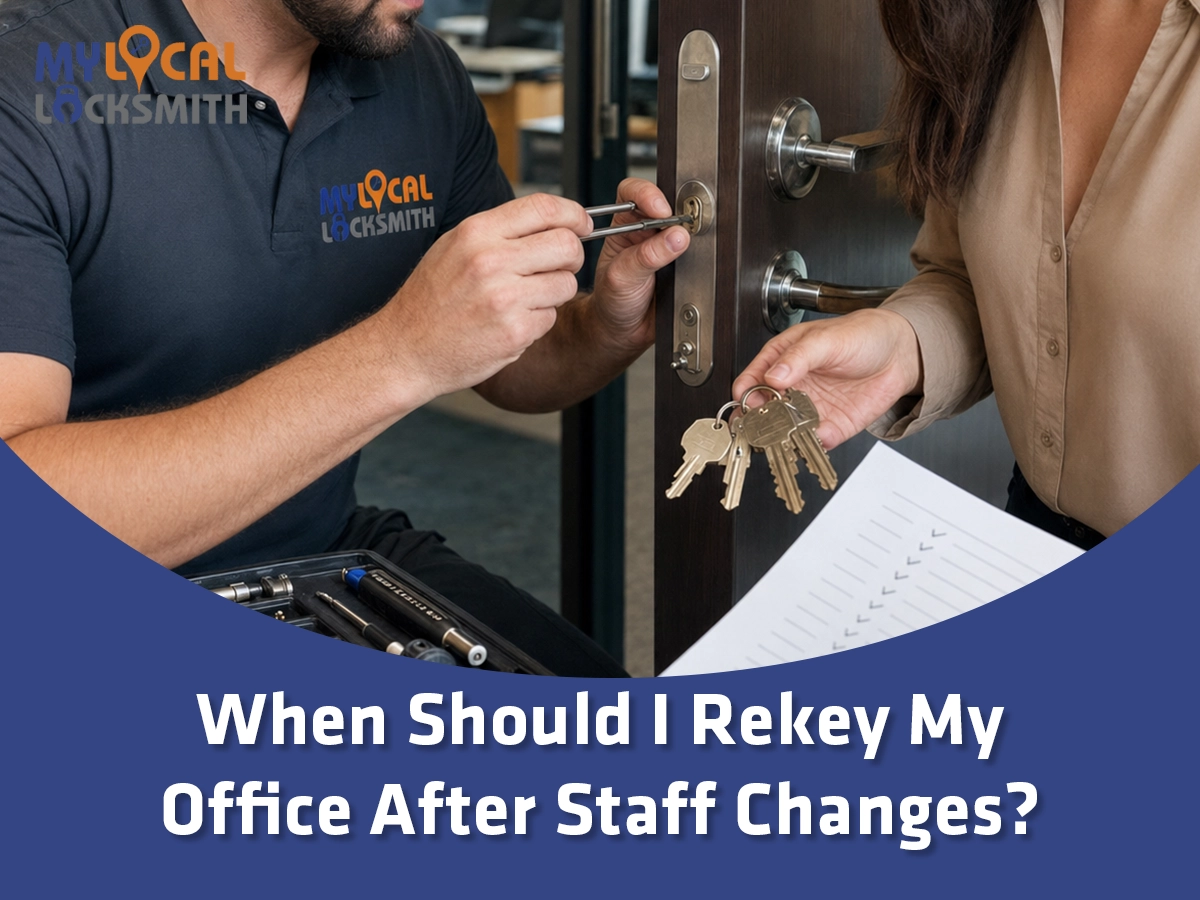
A Practical Flower Mound Guide to Safer Office Access
Here is a surprising fact: a returned office key proves only that one key came back. It cannot prove that nobody made another copy. Therefore, staff changes should trigger an access review, even when an employee leaves on friendly terms.
AI Overview: Rekey your Flower Mound office promptly when a departing employee does not return every assigned key. The same advice applies when a key may have been copied, shared, lost, or tied to a master system. Rekeying changes the working key without replacing sound lock hardware. However, a verified return may not require every lock to be rekeyed. First, review the key log, access level, door list, departure conditions, and security needs. Then, rekey only the affected locks, replace worn hardware, or disable electronic credentials. A licensed commercial locksmith can inspect the system and help define the right scope.
- Review every physical key, badge, code, and remote credential.
- Match each credential to the doors and rooms it could open.
1. Rekey at Once When an Office Key Is Missing
The clearest rekey trigger is an unreturned key. It does not matter whether the employee says the key is lost. Once management cannot account for it, control has changed.
This is especially urgent when the missing key opens an outside door. The same concern applies to server rooms, record rooms, cash areas, and supply rooms. Those spaces may hold private data, costly equipment, or items needed for daily work.
A missing key does not prove a threat exists. Still, it creates uncertainty that records alone cannot remove. Rekeying the affected cylinder makes the old key useless. As a result, the office regains known control.
- Rekey affected exterior and sensitive doors as soon as practical.
- Document the missing key, affected doors, service date, and new key holders.
2. Act Quickly After a Difficult Staff Departure
An involuntary or tense departure needs coordinated planning. Human resources, management, information technology, and facility staff should agree on timing. Physical and digital access should end together whenever possible.
The federal CISA guide for adverse employee separations treats separation risk as a planned management issue. That approach is useful for private offices too. A clear process protects people, property, information, and the departing worker’s dignity.
Rekeying is reasonable when the departing person held an office key and return cannot be verified. It is also reasonable when management has a documented reason to doubt key control. However, the decision should rest on access facts, not rumors.
- Collect keys and badges before the final departure when company policy permits.
- Disable alarm codes, door codes, badges, and mobile credentials at the planned time.
3. Audit Every Door Before Choosing the Rekey Scope
Many offices have more access layers than managers realize. A front door key may differ from a suite key. A manager may also hold keys for storage, files, utilities, or another building.
Therefore, do not tell a locksmith to rekey every door before mapping the system. First, list the doors each departing employee could open. Next, identify shared keys, master keys, and electronic credentials. This step often narrows the work.
The audit should include cabinets and gates when they protect important assets. It should also cover keys stored in desks, lock boxes, vehicles, or offsite locations. Even a key marked “do not duplicate” may need review because markings alone do not create an audit trail.
For a wider planning approach, review this guide to commercial door lock hardware. It helps managers connect cylinders, levers, closers, and exit devices to real access needs.
- Create a door list with location, lock type, key group, and current users.
- Mark exterior, private, regulated, valuable, and life safety areas.
4. Know When a Returned Key Is Not Enough
A returned key lowers uncertainty, but it does not always close the issue. The employee may have shared the key with a contractor or coworker. A copy may also exist because past key records were incomplete.
Consider the full custody history. Was each key numbered? Did the employee sign for it? Did management control duplication? Did the key ever go missing? If the answers are unclear, a rekey may be the cleanest reset.
The type of key matters too. A restricted key system may offer better copy control than a common key blank. An electronic system may show credential activity. A standard metal key usually provides no record of when it was used or copied.
This does not mean every returned key is unsafe. Instead, it means the return is one part of the decision. Good records can support a smaller response. Weak records often justify a broader reset.
- Confirm how many keys were issued and how many were returned.
- Ask whether copies, temporary loans, or contractor access were recorded.
5. Treat a Lost Master Key as a Major Event
A master key can open several doors within one system. Therefore, its loss may affect far more than one office entrance. The exact exposure depends on the key hierarchy and the cylinders it controls.
Do not assume that every lock must change. A commercial locksmith should review the master key chart and identify the affected level. Some systems allow a focused rekey. Other systems may require changes across many doors.
This is also the right time to ask whether the current hierarchy grants too much access. A manager may need the front entrance and common rooms, but not files or server areas. A revised system can reduce the impact of a future lost key.
The article about master key systems and business security explains how access levels can simplify use without giving every person the same reach.
- Secure high value areas while the master key exposure is reviewed.
- Rebuild access levels so each role receives only the access it needs.
6. Rekey Sensitive Rooms Even When Entry Keys Are Safe
Not every staff change affects the main entrance. A departing payroll worker may hold a file room key. A technology worker may open a server closet. A supervisor may control inventory, medicine, tools, or cash.
In these cases, rekeying only the sensitive room may be enough. This focused action reduces cost and avoids replacing keys for the entire team. It also matches the response to the actual exposure.
Decision makers should consider what the room protects. Private records, payment data, customer information, and regulated items may require tighter access. The business should follow its own policies and any rules that apply to its work.
- Prioritize rooms containing private data, money, equipment, or controlled stock.
- Limit new keys to roles that need regular access to those rooms.
7. Choose Rekeying When the Hardware Still Works Well
Rekeying and lock replacement solve different problems. Rekeying changes the internal key combination. The existing lock body, lever, and related hardware remain in service.
Therefore, rekeying is usually appropriate when the lock works smoothly and meets current needs. It restores key control without paying for unnecessary hardware. The locksmith should still inspect the cylinder, latch, strike, alignment, and door operation.
Replacement makes more sense when hardware is worn, damaged, loose, unsuitable, or difficult to use. It may also be justified when the business wants a restricted key system, stronger commercial hardware, or electronic access.
This comparison of rekeying and lock replacement discusses the basic difference. Commercial offices need an added review of door use, key levels, and exit requirements.
- Rekey sound locks when the main problem is uncertain key possession.
- Replace hardware when condition, function, security, or access needs have changed.
8. Protect Safe Exit While Improving Entry Security
Office security cannot block emergency escape. New cylinders, levers, exit devices, and access systems must work with the door’s safety role.
The OSHA exit route standard says employees must be able to open an exit route door from inside without keys, tools, or special knowledge. It also warns against devices that could restrict emergency use if they fail.
Therefore, a rekey appointment should not become an improvised hardware change. A locksmith should identify fire doors, exit doors, panic devices, closers, and access controlled openings before changing components. Local code requirements may also apply.
After service, each affected door should latch, lock, unlock, and close correctly. Exit operation should remain simple from the occupied side. If a door serves a special use, the business may need review from its property manager or local authority.
- Keep required exit operation available throughout the work.
- Test latching, closing, outside access, and inside release after service.
9. Use a Clear Staff Change Rekey Decision Test
A simple test helps managers make consistent choices. Start with the key, then follow its access. Next, consider the reliability of records and the value behind each door.
Rekey promptly if any answer shows lost control. This includes a missing key, an unknown copy, an untracked loan, or a compromised master key. Also act when a sensitive room remains open to someone who no longer needs access.
A full office rekey may not be needed when every issued key is verified, copying was controlled, and no sensitive access remains. Even then, revoke digital credentials and update records. The audit should show why management kept the current locks.
In our professional view, a written decision is better than an automatic rule. It creates a repeatable process for future staff changes. It also helps the locksmith quote the correct scope before work begins.
- Rekey when key control cannot be verified with reliable records.
- Keep existing keying only when access, returns, and affected doors are clearly confirmed.
10. Follow a Smart Office Rekey Process
The work should begin with permission and scope. The business representative should identify the property, approve the doors, and explain the needed access levels. A professional locksmith should inspect before giving a final service plan.
Next, decide how many new keys are needed. Too few keys can disrupt work. Too many keys can recreate the same control problem. Each copy should have an assigned holder or secure storage purpose.
Texas regulates locksmith work through its Private Security Program. The Texas Department of Public Safety licensing system includes a public search for licensed individuals and companies. Business owners can use it when checking a provider.
After rekeying, test every new key in every assigned door. Then confirm that old keys no longer work in the changed cylinders. Finally, update the key log before anyone leaves the site.
- Approve the door list, key groups, quantities, and authorized contact in writing.
- Test new keys, retire old keys, and record every new assignment.
11. Build Better Key Control After the Rekey
A rekey restores control at one moment. A key control process helps preserve it. Without that process, unknown copies can return within weeks.
Use a simple key register. Record a unique key number, issue date, holder, permitted doors, return date, and manager approval. Keep the list secure because it reveals how the office is protected.
Set rules for loans and copies. Staff should know where to report a missing key and how quickly to report it. Managers should avoid storing labeled spare keys in unlocked desks or obvious cabinets.
Regular maintenance matters as well. A key that sticks may signal wear, dirt, alignment trouble, or a damaged cylinder. This guide to lock maintenance for property and office owners can support a routine review.
- Review the key register after every hire, role change, departure, and reported loss.
- Store spare and master keys in controlled storage with limited access.
12. Consider Access Control for Frequent Turnover
Offices with frequent staff changes may outgrow standard metal keys. Electronic access can let an authorized manager disable one badge, code, or mobile credential without rekeying every door.
However, electronic access is not a complete answer by itself. The system needs clear administration, reliable power planning, secure accounts, and regular credential reviews. Mechanical override keys must also remain controlled.
A hybrid design often works well. Exterior and high traffic doors can use managed electronic access. Selected rooms can keep restricted mechanical cylinders. The right mix depends on traffic, budget, lease limits, and security needs.
Before upgrading, compare the cost of repeated rekeying with the full cost of a managed system. Include hardware, installation, administration, maintenance, batteries, software, and future support. This guide on access control for small businesses can help frame that review.
- Consider electronic access when roles and credentials change often.
- Keep physical override keys controlled, counted, and reviewed.
13. Learn From a Realistic Flower Mound Office Example
Consider a representative example. This example is not a claim about a specific customer. It shows how a business can apply the decision process without overreacting.
A Flower Mound office has one exterior key, one storage key, and electronic badges. A departing supervisor returns the exterior key and badge. However, the storage key is missing, and the key log does not show whether a copy exists.
The office disables the badge at departure. Management then asks a locksmith to inspect the storage cylinder and exterior hardware. Because the exterior key is verified and controlled, the main entrance keeps its current keying. The storage room is rekeyed, and new keys go only to two managers.
This focused response restores control over the exposed room. It also avoids changing every employee’s entrance key. The office then updates its register and adds signed key receipts for future assignments.
- Match the response to the doors the missing key could actually open.
- Record the reason for rekeying and the reason other locks remained unchanged.
14. Make the Final Rekey Decision With Confidence
So, when should you rekey your Flower Mound office after staff changes? Rekey promptly when physical key control is uncertain. Act at once for missing master keys, exposed exterior doors, and sensitive rooms.
You may not need a full rekey when every key is verified and duplication was controlled. Still, complete an access audit, revoke digital credentials, and update the key register. A staff change should never pass without a documented review.
The best scope is neither the smallest nor the largest. It is the scope supported by the door list, key hierarchy, access records, hardware condition, and business risk. That approach protects the office while respecting time and cost.
My Local Locksmith – Flowermound can inspect affected commercial locks, explain the available options, and help plan a practical rekey. Ask for a clear scope before work begins. Then, keep the new key record current after service.
- Rekey affected locks when old access cannot be ruled out.
- Improve key control so the next staff change is easier to manage.
Frequently Asked Questions
Should I rekey my office after an employee leaves?
Rekey when the employee held a physical key that was not returned or cannot be verified. You should also rekey when copies may exist or the key opened a sensitive area. If every key is documented and returned, an audit may be enough. Still, disable badges, codes, and other digital access promptly.
Is rekeying better than replacing office locks?
Rekeying is often the better choice when commercial lock hardware remains safe, suitable, and reliable. It changes which key operates the cylinder while keeping the existing hardware. Replacement is more appropriate when a lock is worn, damaged, poorly matched to the door, or due for a security or access upgrade.
How quickly should a business rekey after staff changes?
The work should be scheduled as soon as practical when a key is missing, access is uncertain, or a sensitive area is exposed. Electronic credentials should be disabled at the planned departure time. A routine, well documented departure may only require an immediate audit, followed by targeted service if that review finds a gap.
Do I need to rekey every office door?
Not always. The correct scope depends on which locks the former employee’s key could open. A standard key may affect one door, while a master key may affect many. A locksmith can review the key hierarchy and door list. That review may support a focused rekey instead of changing the entire office.
Can electronic access control prevent future rekeying?
Electronic access can reduce rekeying because an authorized manager can disable individual credentials. However, mechanical override keys, shared codes, and backup access still require control. The system also needs secure administration and routine audits. Businesses with frequent turnover should compare a managed access system with the cost of repeated mechanical rekeying.
Conclusion
Staff changes do not create the same risk in every office. The key question is whether management still controls every credential that opens the workplace. When that answer is uncertain, a targeted rekey can restore control quickly.
Start with facts. Count returned keys, map affected doors, revoke electronic access, and review sensitive spaces. Then, choose rekeying, replacement, or an access upgrade based on the actual gap. This careful process protects people, property, records, and daily operations.
- Use a written offboarding and key control checklist for every departure.
- Ask a qualified commercial locksmith to inspect complex or master keyed systems.
Contact My Local Locksmith – Flowermound
Need help deciding which office locks should be rekeyed? Contact My Local Locksmith – Flowermound for a commercial lock review and a clear service plan.
Contact us at
Address: 3535 Firewheel Dr Suite 101, Flower Mound, TX 75028
Main Phone: 469-820-8765
Website: https://mylocallocksmithtx.com/